How Can You Tell?
Should Whoever Is Paying Demand a Refund?
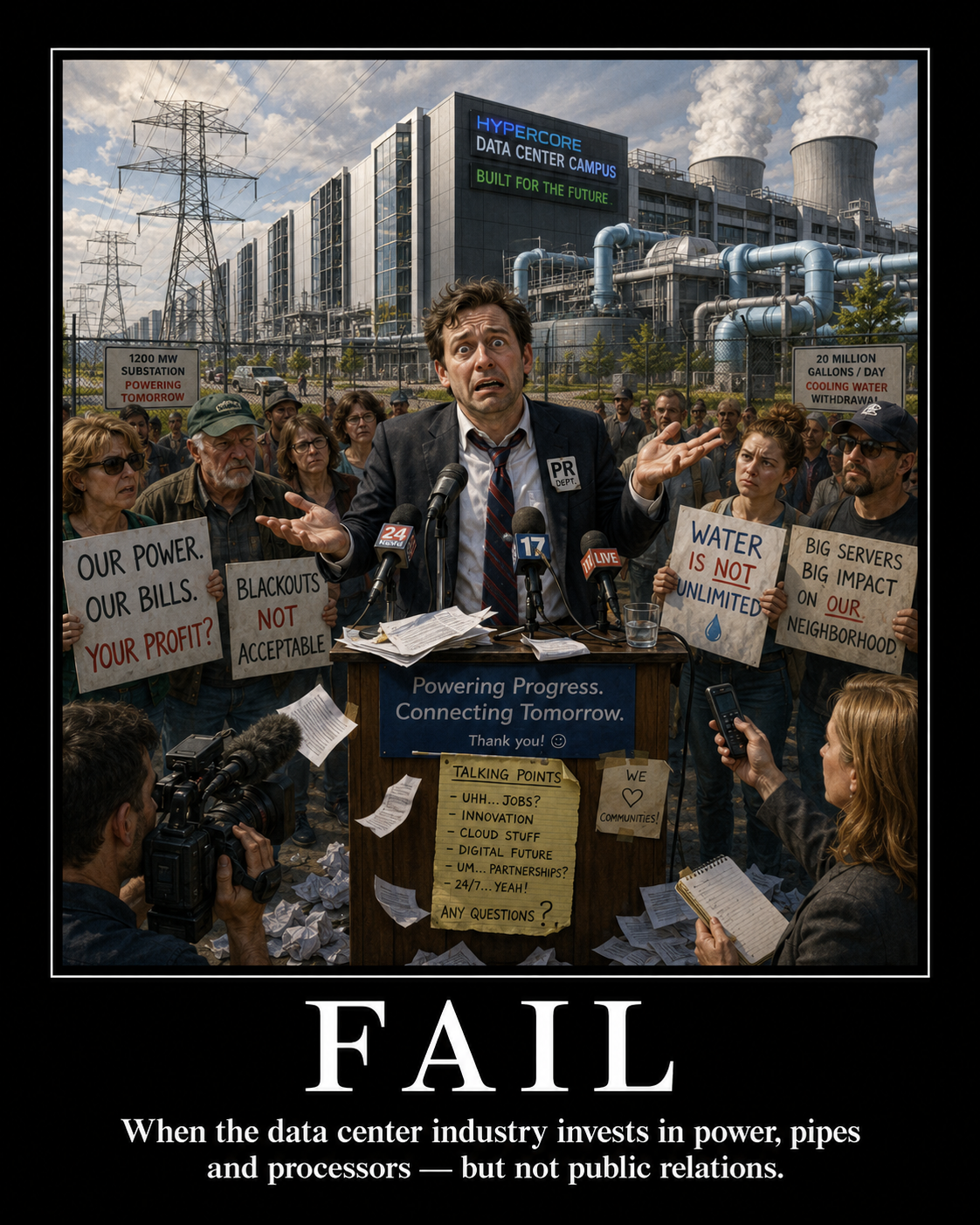
Is anyone doing public relations for the data center industry? Data Centers are just popping up all over. Why? Because demand for data-based products and services is skyrocketing. Artificial intelligence demands more data processing capability. This amount of process takes tremendous amounts of electricity. That demand takes power in the form of electricity away from residences and other businesses. More demand means scarcity and higher prices. More demand means electricity generation plants have to get built. Or as the Internet explains it. ‘With the explosive growth of artificial intelligence, modern data centers require massive amounts of electricity and water to train models and run specialized graphics processing units (GPUs). Because of this, tech companies are increasingly investing in renewable energy and advanced, localized cooling infrastructure to keep these facilities sustainable.’
So what’s the problem? There are several. First, most do not want these facilities built anywhere near them (more about the old ‘not in my backyard’ or ‘nimby’ below). Second and most important, the industry is ineffectual defending its reputation. Hear, see or read a negative story about data centers and waiting for the rebuttal? It will be a long wait. So below is an exploration of the abysmal reputation management done by this industry and how to fix it.
Fail
This is a real reputation failure: national opposition, local moratoria/recall efforts, and a widening gap between “AI infrastructure is essential” messaging and residents’ worries about bills, water, noise, secrecy, and tax breaks.
All jokes aside, there is a public relations effort underway. But the industry appears to be losing the reputation argument because the communications arrive late, sound defensive, and often fail to address local fears.
The short version is this: data centers are and were marketed as “the cloud,” “AI infrastructure,” “economic development,” and “jobs.” Add to this ‘we cannot let the Chinese win’ as a credible reason to go ahead with more data centers. At least so far none of these arguments made power sucking monstrosity more palatable.
Public Relations and Community Reality
Communities experience data centers as giant industrial power users that may raise electric bills, consume water, add noise, require new gas plants to generate electricity, receive tax breaks, and arrive through sometimes hard to decipher local approval processes. That is not just a message gap or bad P.R. It is a credibility gap for an industry that no one trusts.
Is Anyone Doing Public Relations or Reputation Management?
Incredibly yes. The industry has trade association, agency, and public affairs infrastructure. The Data Center Coalition describes itself as the industry’s voice for public policy, stakeholder outreach, and community engagement. It also publishes industry-friendly reports, including a May 2026 report arguing that there is “no historical evidence” that data centers are driving residential electricity increases under existing rate structures. While this may be true, credibility of the source is questionable.
Even more incredible, there are agencies who market themselves as Data Center specialists. JSA says data center PR in 2026 now includes AI infrastructure positioning, community impact, energy strategy, security, crisis management, and long-term stakeholder trust. Milldam PR says the industry has been caught off guard by community pushback and identifies “lack of a cohesive community engagement strategy” as a major roadblock. Engage PR makes a similar case, saying operators face community opposition and pressure to justify energy and land use. Why not just go and find ‘Bagdad Bob’ and see if he is still working?
Why are you so terrible at public relations?
So, the answer is not “there is not anyone doing PR.” The answer is worse for the industry: they are doing PR, but much of it is not solving the problem and most of it is ignored. This is a bad place to come from, a very deep reputational hole from which to extract ones industry.
The facts are hard to message around. The International Energy Agency projects global electricity generation needed for data centers to rise from 460 TWh in 2024 to more than 1,000 TWh in 2030. In a high-growth case, the IEA says much of the extra demand beyond planned growth could be met by fossil fuels because of grid connection delays.
What the Polls Say About Public Relations
That collides directly with what communities’ fear. Gallup found in May 2026 that seven in ten Americans oppose building AI data centers in their local area, including 48% who strongly oppose them. Gallup also found that opposition is tied to concerns about resources, water, electricity, grid constraints, utility bills, pollution, noise, and quality of life.
This has moved beyond environmental groups. S&P Global reports that opposition has grown from Northern Virginia to the Columbia River, centered on energy, environmental, and affordability impacts. It also reported that 20 projects were delayed or canceled in recent months, representing an estimated $100 billion in investment. That is a lot of money and a sign that the opposition is not just winning, it is overpowering the data center movement.
In Texas, this is already local politics. The Houston Chronicle reported that Gov. Greg Abbott called for prohibiting AI data centers in rural Texas neighborhoods and reiterated that new centers should bring their own power, reuse water, and avoid raising residents’ electricity costs. As a Texan, this is an astounding piece of news as Texas is one of if not the most business friendly states in the union.
Why the Public Relations Feels So Bad
The industry is using a permission strategy when it needs a legitimacy strategy. A permission strategy says: “We have site control, incentives, a utility agreement, and local officials lined up. Now let’s explain the benefits and why you are stupid if you don’t agree with us.” Or, more succinctly, ‘we do not need to worry about public opinion, because the law is on our side and we get to build our thing, so piss off.’
A legitimacy strategy says: “Before this project is approved, the public deserves to know why this data center is necessary, who is building it, how much power it will use, where the power will come from, what if anything it will do to rates, how much water it will consume, what noise it will produce, what tax breaks it receives, how many permanent jobs it creates, and what enforceable protections the community gets and who or what agency will oversee and enforce regulations in the name of public safety.”
The first approach feels arrogant, dismissive and as such creates backlash. The second approach is more genial, recognizes that the best communications are two way and acknowledges the legitimacy of the public and its role in the process. At the end of the day, data centers operate with and receive their licensing with public permission.
The Industry’s Core Communications Public Relations Failures
First, secrecy is killing trust. Communities are not just reacting to megawatts and water. They are reacting to the feeling that decisions are made before the public is invited in. The Guardian reported that residents in Lenox Township, Michigan packed meetings and pursued recall petitions after perceived secrecy around a proposed data center. It also reported that people across the U.S. are pushing moratoriums and recalls over similar projects.
Second, the industry’s benefits argument is too generic. “Jobs and tax revenue” is not enough when people believe the facility will use huge amounts of electricity and water but employ relatively few permanent workers. Gallup found supporters cite economic benefits and jobs, but opponents focus more heavily on resources, costs, environmental effects, pollution, and quality of life.
Third, the power plant issue changes everything. Once a data center becomes associated with a new gas plant, a revived fossil site, diesel backup, or ratepayer-funded transmission upgrades, it is no longer a “technology” story. It is an energy, environment, and household-cost story. Spotlight PA/Inside Climate News reported that Pennsylvania data center developers plan to rely on at least seven new gas-fired power plants, including behind-the-meter plants meant to serve data centers directly.
Fourth, the industry is often speaking to investors and policymakers, not neighbors. “Digital infrastructure,” “AI competitiveness,” and “cloud capacity” may work in trade publications. They do not answer Mrs. Johnson at the school board meeting who wants to know whether her electric bill goes up, whether the town’s water supply is safe, and why an NDA prevented her from knowing who was behind the project.
Fifth, dismissing opponents is disastrous. Calling concerns exaggerated, emotional, anti-technology, or politically manipulated only hardens opposition. The Guardian reported that claims tying opponents to foreign influence have been made without evidence in at least one high-profile case, and that backlash now includes both Democrats and Republicans.
Next: What good reputation management would look like
The industry needs to stop treating public relations as a post-announcement cleanup function. For these projects, PR should begin before land acquisition becomes public, before incentives are negotiated, and before the utility story is locked. But you will have to come back to see that.