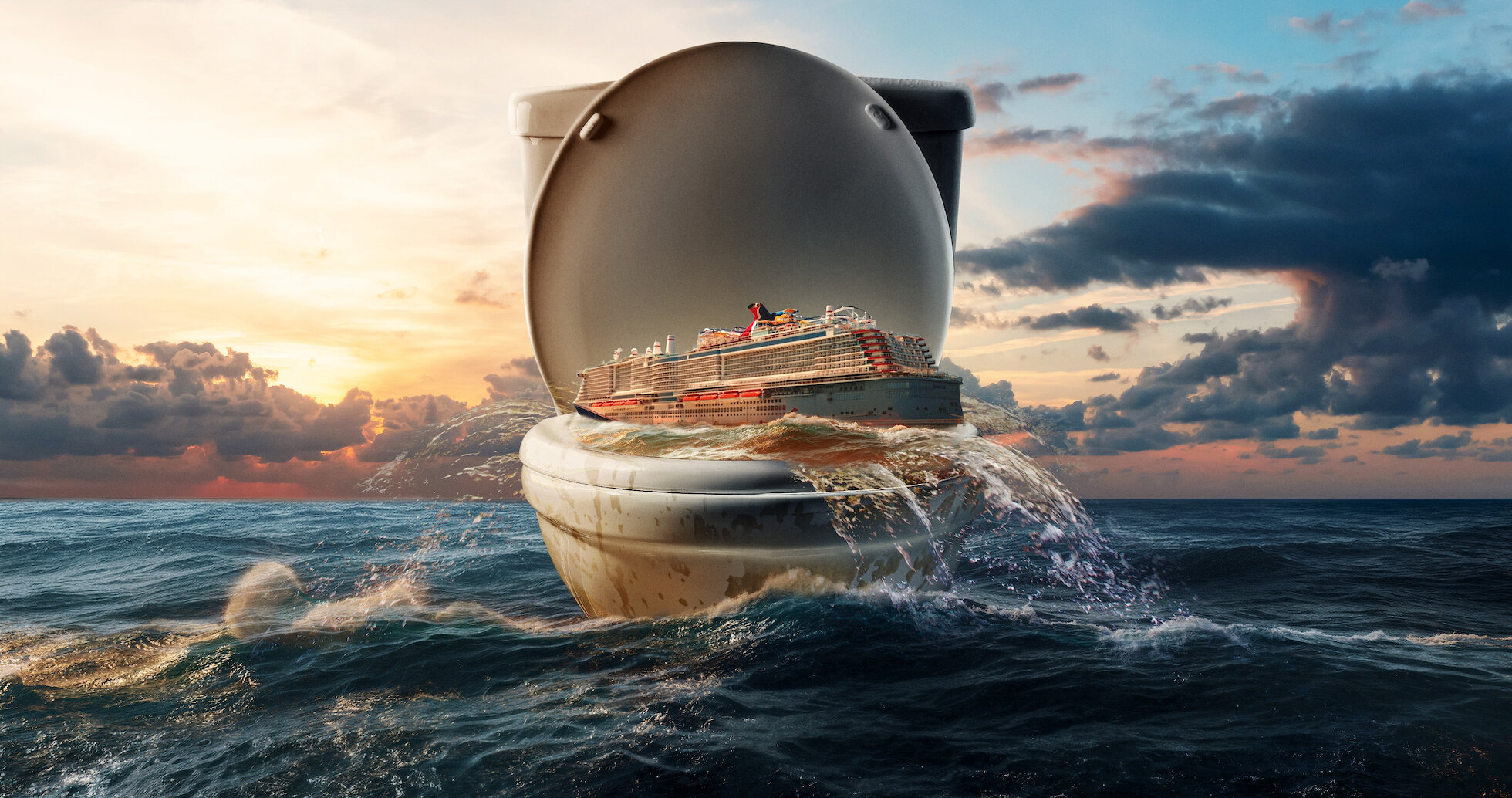
A story of how to completely, totally, absolutely screw the pooch….
The Netflix Trainwreck Series Poop Cruise a Public Relations Fiasco. No matter what or who we are, all we have is our reputation. It is true of people, clubs, churches, businesses of all size, resorts and cruise lines. People in the public relations business are ultimately also in the reputation trade. Reputations matter. It was the public relations and reputation angle that attracted me to the poop cruise, or, Netflix Trainwreck Documentary Poop Cruise.
Poop Cruise
Watching the Netflix Trainwreck series “Poop Cruise” reminded me of all the things I learned about the cruise industry when I was working with a corporate governance client. Poop Cruise is part of the ‘Netflix Trainwreck’ documentary series covering the February 2013 events aboard the ‘Carnival Triumph.’ The story is not new, but the documentary is, and that is why it got my attention. For instance….
I remembered from my corporate governance work is many, if not most, cruise lines are not registered in the U.S. and not subject to U.S. laws. From an ethical, legal and regulatory point of view, cruise lines are a mess. This knowledge was accompanied by my other memory about the number of crimes committed at sea, mostly by the hired crew members against passengers, that were not resolved because of the lack of legal standing*
Foreign Based Cruise Lines
Foreign registry means cruise lines operate under the laws of the country where they are registered, not necessarily the country of their parent company or where they primarily operate. Carnival’s office was located in Miami, Florida. It sailed out of Galveston, Texas and the majority of passengers were Americans.
Carnival claims a strong focus on safety and security, with regular inspections and adherence to international law. Sounds good! Except law enforcement involvement in incidents on board foreign registered ships depends on several factors, including the location of the incident and the nationalities of those involved. Safety and operational integrity are the same, ruled by the country of registration.
Panama
The majority of Carnival’s fleet is registered in Panama. Non-U.S. registry is a common practice in the cruise industry due to factors like lower registration fees and less stringent regulations. Those relaxed standards may be relevant to the way Carnival chose to manage its electronic and electrical infrastructure (which failed dramatically on Triumph). Many safety challenges were present on the ship and shown on the documentary. Communications with the public via the media during the infamous ‘poop cruise’ (which was also a callosal disappointment) was also a failure.
Who was the Public Relations Agency, Really?
According to the InternetHill+Knowlton Strategies (often abbreviated as H+K Strategies) managed crisis communications and media relations for Carnival, particularly during the high-profile incidents in 2013 such as the Carnival Triumph engine fire. The firm played a key role in coordinating PR efforts during this time of increased scrutiny. Maybe after the fact. But the situation vis-a-vis public relations was beyond any type of redemption way before H&K got involved, as you will see as you read on.
The documentary shows a man named Buck Banks of Newman Public Relations as the public relations agency contact who made the first announcements about the status of the Carnival Triumph. On the film, he describes how he wrote and distributed a press announcement about a fire onboard Triumph. Banks described this as a “holding statement.” (These are a common crisis tool that acknowledges the situation and what is known, provides a media contact for the press, etc.).
We do not see any more of Banks’ public relations efforts as far as written announcements or media outreach during the documentary. That is not to say there were not any. But none are mentioned and locating those materials twelve years later is problematic.
Here is a reconstructed version of that holding statement:
Reconstructed Press Summary (Feb 10–11, 2013): “On Sunday, February 10, the Carnival Triumph experienced an engine room fire that was quickly extinguished by onboard systems. There were no injuries. The ship is operating on emergency power and will be towed to Progreso, Mexico. All guests are safe and being provided with food and accommodations. Carnival sincerely apologizes for this inconvenience and is doing everything possible to ensure the comfort of our guests.”
While everything in this release was thought true when it was written, Triumph was not towed to Progresso, Mexico. It was towed to Mobile, Alabama which as far as we are told was never announced to the public. Worse, it does not begin to capture the real conditions aboard Triumph.
A Failure to Follow Up
There is no record of any follow up from Banks or Newman PR after the holding statement. That the ship was dead in the water and drifting in what was known then as the ‘Gulf of Mexico’, had no electricity, working toilets or showers, refrigeration, or even hot water to wash dishes. We see Mr. Banks get excited about managing the situation as a crisis after guests were able to piggyback cell phone and internet connections from a re-supply ship. In that short window of time passengers contacted family members who in turn called media.
It was way past too late for Buck Banks and Newman Public Relations. This was where we might have seen a focused crisis communications plan. That we did not see anything like that does not mean there was not one in place but the outcome and quotes from Buck Banks cause me to believe there was not one.
Banks predicts that once the ship returned to the U.S. he expected a beat down from the news media. Banks said in the Netflix doc that he still “anticipated a complete media blood bath” when they docked. But he was met with something else.
Luck is not a Strategy
Banks said they were “shocked and relieved that so many of them (passengers) credited the Carnival crew members with superhuman effort.” Banks was lucky that time, but reliance on luck alone is a terrible strategy. Saying out loud that there was an element of this that was unexpected and from all appearances, unprepared for is also telling.
The lesson for non-public relations practitioners from this incident is to have a crisis communications plan written and in place, where all the facts whether good or bad, get told early and often.
By revealing negatives from the start, the media will not be able to make any of their coverage about how an organization tried to cover up negative information.
Self-reporting removes the suspicions that an organization has ‘something to hide’ and will reinforce credibility, even under the worst circumstances. So, tell it all and tell it as soon as possible.
Ignore the Lawyers
Corporate lawyers will often not like this because they will claim it opens the company up to lawsuits. But the company is getting sued regardless. The situation in the documentary is obvious and who was at fault. Nothing the company tried to not say would prevent lawsuits.
The same is true for the chemical plant that released an enormous cloud of chlorine gas, or the auto manufacturer with cars that have faulty steering wheels, etc. Not saying anything is good advice for someone arrested and in the back of a police car. But staying silent in crisis business situations will only reinforce negative perceptions. Silence allows the media and the public to make up their own stories and jump to conclusions as to why a company is not more forthcoming.
Nature hates a vacuum. Information vacuums will be filled by public relations people who work to keep the public informed or by the media who are prone to seek and speculate about the most negative outcomes.
Retrospective Commentary
- Documentaries such as Netflix’s crisis retrospectives point out that Carnival’s PR was reactive, not proactive.
- Interviews with crisis experts suggest the PR team underestimated the speed of digital communication from passengers.
- A broader conclusion is drawn that corporate crisis protocols at the time were not prepared for real-time social media amplification.
Scholarly Analysis
- Scholars in crisis communication now use the Triumph case as a case study in failed early messaging and the importance of public empathy and rapid transparency.
Contact the Writer
If you or someone you know needs a crisis communications plan, please contact me at info@media-public-relations.com, haroldnicoll@gmail.com, or text me at 443-987-0195. To learn more about our agency’s capabilities, please visit the website at https://media-public-relations.com.
Notes about Public Relations and Poop Cruise
Summary of PR Activity in 2013 (Carnival + Hill+Knowlton Strategies)
- Crisis Focus: The central PR effort in 2013 was surrounding the Carnival Triumph engine fire incident in February. The ship was stranded at sea for days without working plumbing, leading to media labeling it the “Poop Cruise.”
- PR Strategy:
- Hill+Knowlton took charge of crisis management and damage control messaging.
- They worked to position Carnival as transparent, accountable, and focused on passenger safety and recovery.
- Carnival issued public apologies, offered refunds and compensation, and attempted to control the narrative through mainstream outlets.
- Key Messages: Efforts were concentrated around:
- Immediate concern for guests’ safety.
- The rarity of the incident.
- Financial reimbursement and transportation support.
- Media Placement: Coverage was coordinated across CNN, MSNBC, and major newspapers through briefings and controlled interviews, mitigating misinformation.
- Internal Memo Leaks: According to a New York Times summary, some internal communications highlighted the urgency with which Hill+Knowlton was brought in after the negative public sentiment surged.
* Recent Cruise Ship Crime Data (First Quarter of 2025):
- According to data from the Department of Transportation, there were 48 allegations of crimes reported onboard cruise ships leaving the U.S. between January 1 and March 30, 2025.
- Of these, 23 were reported as rapes, 10 as sexual assaults, and 7 as assaults.
- There were also 7 assaults with serious bodily injury and 7 thefts of more than $10,000.
- These numbers represent a two-year high for cruise ship crime rates.
Context and Contributing Factors:
- Some experts suggest that the increase in crime rates might be related to the increase in passenger numbers as the cruise industry rebounds from the COVID-19 pandemic.
- Large gatherings of people in a confined space, particularly when alcohol is involved, may also contribute to the potential for increased incidents.
- Some sources suggest a correlation between excessive alcohol consumption and violence, including sexual violence, on some cruise lines.
Cruise Line Safety Measures:
- Cruise lines are required by the Cruise Vessel Security and Safety Act (CVSSA) of 2010 to report certain crimes to the FBI.
- These reported incidents include physical assaults, rape, and sexual assaults.
- Cruise lines also have security teams onboard to help keep passengers safe.
Overall Perspective:
- While these statistics highlight that crimes can occur on cruise ships, it’s important to remember that millions of passengers travel by cruise each year.
- Some experts argue that, when considered in the context of overall passenger numbers, the rate of violent crime on cruise ships is significantly lower than in many major cities.
Important Notes:
- The U.S. Department of Transportation publishes quarterly incident reports detailing crimes on cruise ships.
- The FBI investigates serious crimes on cruise ships when they have jurisdiction, which depends on factors like the location of the incident, the nationality of those involved, and the ship’s flag.
- Passengers can enhance their safety by being aware of their surroundings, securing their belongings, and reporting any suspicious activity immediately to ship security.
Initial Public Relations Response (Day 1–2)
- Carnival released a brief statement saying there had been a fire but that it was extinguished and there were no injuries.
- Passengers were told help was on the way, but external communications from Carnival were minimal.
- No major press conferences or on-the-record interviews were initiated at this stage.
Insight from Media Studies & PR Experts: This early response is viewed as a textbook mistake in crisis communication. By not getting ahead of the story, Carnival left a vacuum that was quickly filled by passenger-generated media.
Passenger Communication Shifts the Narrative (Day 2–3)
- Passengers began texting and calling friends and family as soon as they gained cell service.
- Photos and descriptions of unsanitary conditions (tent cities on deck, overflowing toilets) quickly went viral.
- Social media and cable news amplified the “Poop Cruise” narrative within 48 hours.
Delayed PR Escalation (Day 3–4)
- Only after public perception turned hostile did Carnival begin to:
- Offer more detailed statements.
- Announce compensation: refunds, travel reimbursement, and $500 per person.
- Coordinate with Hill+Knowlton for media strategy and messaging.
Media Impact
- CNN embedded reporters in the story, including interviews with passengers.
- Headlines across the U.S. described deteriorating conditions.
- PRWeek and industry analysts criticized Carnival’s lack of immediacy, transparency, and empathy in the early hours.