A white paper on communication continuity for businesses and the communities they serve
Executive Summary
After any crisis of any type or size, a company can restore its systems and still lose the confidence of employees, customers, suppliers and communities if it cannot communicate during the interruption. Email, websites, telephone systems, payment services and internal messaging often depend on the same providers, networks and/or credentials. When those resources fail together, a conventional crisis plan may be inaccessible at the moment it is needed.

Communication continuity requires more than a backup social media account. Leaders should identify critical audiences and possible decisions, map shared dependencies, establish independent ways to reach people, protect offline contact information and practice using those arrangements. The goal is to deliver accurate, useful updates even when the cause and duration of an incident remain uncertain.
Why This Issue Deserves Attention
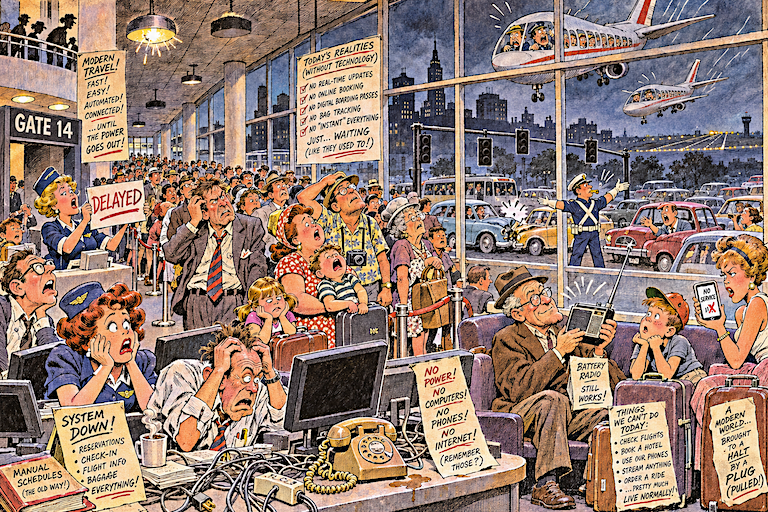
In November 2026, a Microsoft service disruption, a nationwide Federal Aviation Administration ground stop, banking access problems and a United Airlines system outage occurred within days of one another. These were real disruptions, but at this writing there is no known cause, common or not. Their proximity illustrates how quickly questions about essential services, shared dependencies and public confidence converge. [1, 2]
The United Kingdom’s Be Ready campaign provides a related public affairs example. Launched in October 2026, it encourages households to prepare for three days of disruption and engages businesses, charities and local organizations in sharing guidance. The government says the campaign responds to a range of risks rather than a specific imminent threat. It reflects a broader recognition that resilience depends on communication across institutions and communities. [3, 4]

For a business, the immediate risk is practical: employees may not know whether to report to work; customers may not know whether orders or payments are affected; suppliers may continue shipments to a closed facility; and neighbors may have questions about safety. Silence leaves these questions unanswered and makes it harder to correct misinformation. Nothing will cause the public to start making its own stories up faster than silence. Those stories are never favorable to whatever organization(s) are involved.
The Hidden Single Point of Failure
A company may believe it has several channels when those channels depend on one system. Its website and status page may use the same hosting provider; employee email and the contact directory may share an identity system; a text alert platform may require a login delivered to an unavailable email account. A mobile network, power outage or cyber incident can create a different combination of failures. So how to prepare?
Map each important communication path from author to recipient. Record its provider, power and internet needs, authentication method, administrator access and the system that stores its contact lists. Then ask whether the proposed backup can operate if those same dependencies are unavailable. Independence is a design objective to verify, not a label to assume.
| Method | How a company could use it | What it depends on |
| Local AM or FM radio | Give updates through a local station that has agreed to carry them. Employees and residents can listen on battery-powered or car radios. | The station must be operating, and the company needs a way to reach it. |
| Two-way radios | Coordinate among employees at a facility, between nearby locations or with a response team. | Range, charged batteries and, for some systems, functioning repeaters. |
| In-person messengers | Send a designated employee to deliver updates to a facility, community partner or radio station. | Safe, passable roads and available personnel. |
| Posted notices | Place updates at entrances, gates, community centers and other locations identified in advance. | People must be able to reach those locations safely. |
| Meetings and briefings | Give instructions at a predetermined location and time, such as a shift-change meeting or community briefing. | People must know where and when to gather. |
| Traditional wired landlines | Call employees, partners or authorities if the landline network remains operational. | The type of phone service, local network and available power. Many modern “landlines” use internet equipment and may fail in the same outage. |
| Satellite phones or satellite messengers | Reach designated leaders or outside partners when local cell service is down. | Working satellite service, charged equipment, a clear view of the sky and prior testing. |
For a company with a physical facility, build the plan around three basic layers:
- Inside the facility: two-way radios, in-person briefings and posted notices.
- Between facilities and key partners: two-way radio where range permits, a tested satellite device, or designated messengers.
- To the wider public: a prearranged relationship with a local radio station, supported by posted notices and community partners.
These arrangements must be known before the outage. For example, employees should already know: “If you cannot reach us by phone or email, listen to this station, report to this location if safe, or look for a notice at this entrance.”
For southeast Texas, where I live, a business might arrange in advance with a local radio station and community partners to share verified updates. It should also keep a printed list of contacts and instructions, battery-powered radios, spare batteries, and a designated person authorized to deliver information.
Build a Communication Continuity Plan In Advance
Like any crisis management or crisis communications plan, these arrangements and agreements must be made in advance.
1 Set priorities and assign authority
Name a communications lead and at least one alternate, with reachable contact information outside the normal directory. Define who can activate the plan, verify operational facts, approve public messages and speak for the organization. Include operations, information technology, legal, human resources and customer service, but establish a short approval path for urgent safety instructions. Document after-hours coverage and succession.
2 Identify audiences and their needs
List employees, customers, suppliers, investors where applicable, regulators, local officials, emergency responders, news media and nearby communities. For each, identify the decisions they may need to make and the fastest accessible way to reach them. Frontline employees, people with disabilities, those without smartphones and people who speak languages other than English may need different formats or assistance. Confirm any industry-specific reporting obligations with counsel; this paper is not a substitute for legal advice.
3 Establish and test alternate channels
Choose channels appropriate to the incident: an independently hosted status page, an emergency telephone line, a separately administered text-alert service, telephone trees, recorded messages, local radio, physical signs or direct contact through community partners. No channel is universally independent: test its hosting, login, power, carrier and vendor dependencies. Publish the address or number in advance, and tell audiences how to recognize an authentic message.
Maintain a current, access-controlled offline copy of essential contacts, roles, procedures and templates in locations available to authorized staff. Limit personal data, encrypt electronic copies, secure printed copies, assign an owner and refresh them on a defined schedule. Provide a way to revoke access and dispose of outdated copies securely. But this will all have to be printed on paper, filed or placed in notebooks that are visible and accessible.
4 Prepare messages before the emergency
Most people are not at their best during a crisis. So, preparing as much as can be in advance will prevent at least some of the irrational decisions that are more likely when things go badly. Draft short initial messages for a service interruption, facility closure, payment disruption and potential safety incident. Templates should leave room for verified facts and should never assert that data is safe, an attack did not occur, or service will return at a particular time without evidence. Translate or adapt critical instructions in advance where appropriate.
5 Practice under realistic conditions
Run an exercise in which normal email and the primary website are unavailable. Have alternates access the plan without the usual identity system, issue a test update, and reach a representative sample of each audience. Measure time to activate, time to first verified message, delivery and acknowledgment rates, accessibility and time to correct an error. Document gaps, assign owners and retest after major vendor or system changes. Plenty of manufacturing plants have emergency drills. This should be added.
What to Say During an Outage
The first update states only what is known. For example, what is the known impact, the immediate action people should take (if any), where to find reliable updates and when the next update will be issued. Separate confirmed facts from working assumptions. Better still, do not speculate about anything or make assumptions of any type. State only what is known, If the cause is unknown, say so. If an earlier statement changes, identify the correction and its time. Avoid using technical language as a substitute for explaining what the disruption means to the people affected.
A useful initial message could read:
“We are experiencing a disruption affecting [service]. This started at approximately [time and time zone]. Customers may be unable to [specific impact]. Please do the following [specific action or alternative]. Please do not [specific action or alternative]. We are investigating the cause, working closely with government officials/first responders/utility and infrastructure experts to resolve this. We do not yet have a confirmed restoration time. Our next update will be posted by [time] at [independent channel], even if there is no change.”
Set the update interval to the severity and pace of the incident. If little has changed, say so and explain what is being done. Provide a phone or offline option where feasible. Coordinate facts with emergency authorities and affected partners without delaying urgent protective instructions.
A Practical First 30 Days Plan Outline
- Days 1–7: Assign an executive sponsor and communications lead. Identify the five most important audiences and the decisions they will face during an outage.
- Days 8–14: Map primary and backup communication dependencies. Identify who can approve messages and access contact lists when normal systems are unavailable.
- Days 15–21: Select alternate channels, verify administrative access, prepare initial messages and provide secure offline copies to designated leaders.
- Days 22–30: Conduct a short exercise with primary email and website assumed unavailable. Record results, assign corrective actions and schedule a follow-up test.
Leadership Questions
Use these questions as a kind of ‘audit’ of offline communications capabilities:
- Can we reach employees and customers if our email, website and normal login system are unavailable at the same time?
- Who can approve and publish an initial update after hours, and who serves as the alternate?
- Do our backup channels depend on the same cloud provider, network, power source or credentials as our primary channels?
- How will people verify that an update is authentic, and how will we reach those who cannot access digital channels?
- When did we last test these arrangements and close the resulting gaps?
Conclusion
Communication is an operational capability as well as a public relations responsibility. Companies cannot promise that systems will never fail, but they can prepare to explain the impact, give people useful choices and provide updates through channels that have been tested. The time to establish that capability is before the next disruption.
[1] Federal Aviation Administration, “Nationwide Ground Stop: Questions and Answers,” November 2026. https://www.faa.gov/newsroom/nationwide-ground-stop-questions-and-answers
[2] Associated Press, “1.5-hour-long system outage forces United Airlines to delay departing flights,” November 17, 2026. https://apnews.com/article/5a5e5f75bb07f11ffb8750901f0076ff
[3] UK Cabinet Office, “Households encouraged to take small, simple steps to stay prepared in an emergency,” October 22, 2026. https://www.gov.uk/government/news/households-encouraged-to-take-small-simple-steps-to-stay-prepared-in-an-emergency
[4] UK Parliament, “Strengthening Community Resilience,” October 27, 2026. https://hansard.parliament.uk/Commons/2026-10-27/debates/033A4632-E9CB-4301-A756-56212FF2943E/details